 simpcity
 Artificial intelligence is beginning to influence industries far beyond software and finance, including one of the world’s oldest construction materials: concrete.
Concrete mix design traditionally involves balancing several variables, including cement, water, aggregates and admixtures. Engineers need to consider strength, workability, curing time, cost and increasingly the environmental impact of the finished mix.
AI and machine learning can help make this process more data-driven.
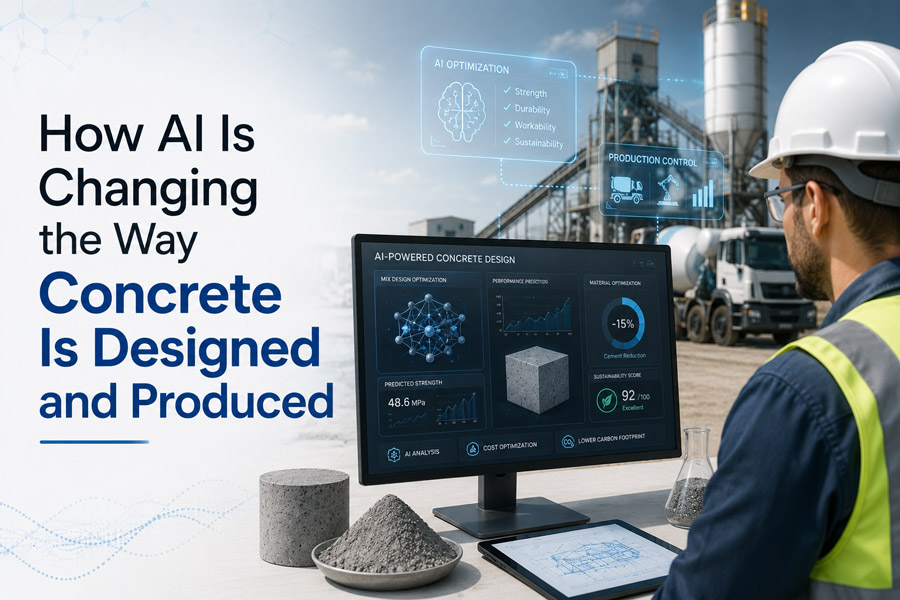
By analysing large datasets of previous concrete mixes, machine-learning models can identify relationships between different ingredients and the performance of the finished concrete. This can help predict characteristics such as compressive strength and highlight potentially effective combinations before extensive physical testing begins.
The technology can also be used to optimise several objectives at once.
For example, researchers are exploring whether AI can help design concrete that reaches the required strength while using less cement, reducing embodied carbon or controlling costs. This could become increasingly important as the construction industry looks for ways to improve sustainability without compromising performance.
AI does not remove the need for physical testing or professional engineering judgement. Concrete still needs to be tested and validated to ensure it is suitable for the intended application. Instead, AI can provide another tool for identifying promising mix designs and reducing some of the trial-and-error involved in development.
This shift towards data-driven construction reflects a wider change in the concrete industry.
Modern suppliers such as Singh Concrete already operate in an environment where efficiency, accurate quantities, suitable mix selection and reliable delivery are increasingly important. Technologies such as volumetric mixing also allow concrete to be produced according to project requirements rather than relying solely on fixed quantities prepared in advance.
As AI, automation and digital monitoring continue to develop, concrete production is likely to become increasingly connected to data.
The future of concrete will still depend on materials, engineering and real-world testing, but software may play a much greater role in helping the industry design and produce concrete more efficiently.
For the latest updates and information, keep checking SimpCity.