 Bilal Khan
Consider a small marketing firm in one of the city’s free zones. A designer who has worked there for two years hands in her resignation, and the founder, who runs payroll himself between client meetings, opens a spreadsheet to work out what she is owed. The numbers look right. They are not. Somewhere in two years of informal approvals and half-remembered days off, three days of leave have gone missing from the records.
In a region where millions of people work far from home, and where annual leave is often the only stretch of time they spend with family abroad, those three days are not trivial. Neither is the money attached to them.
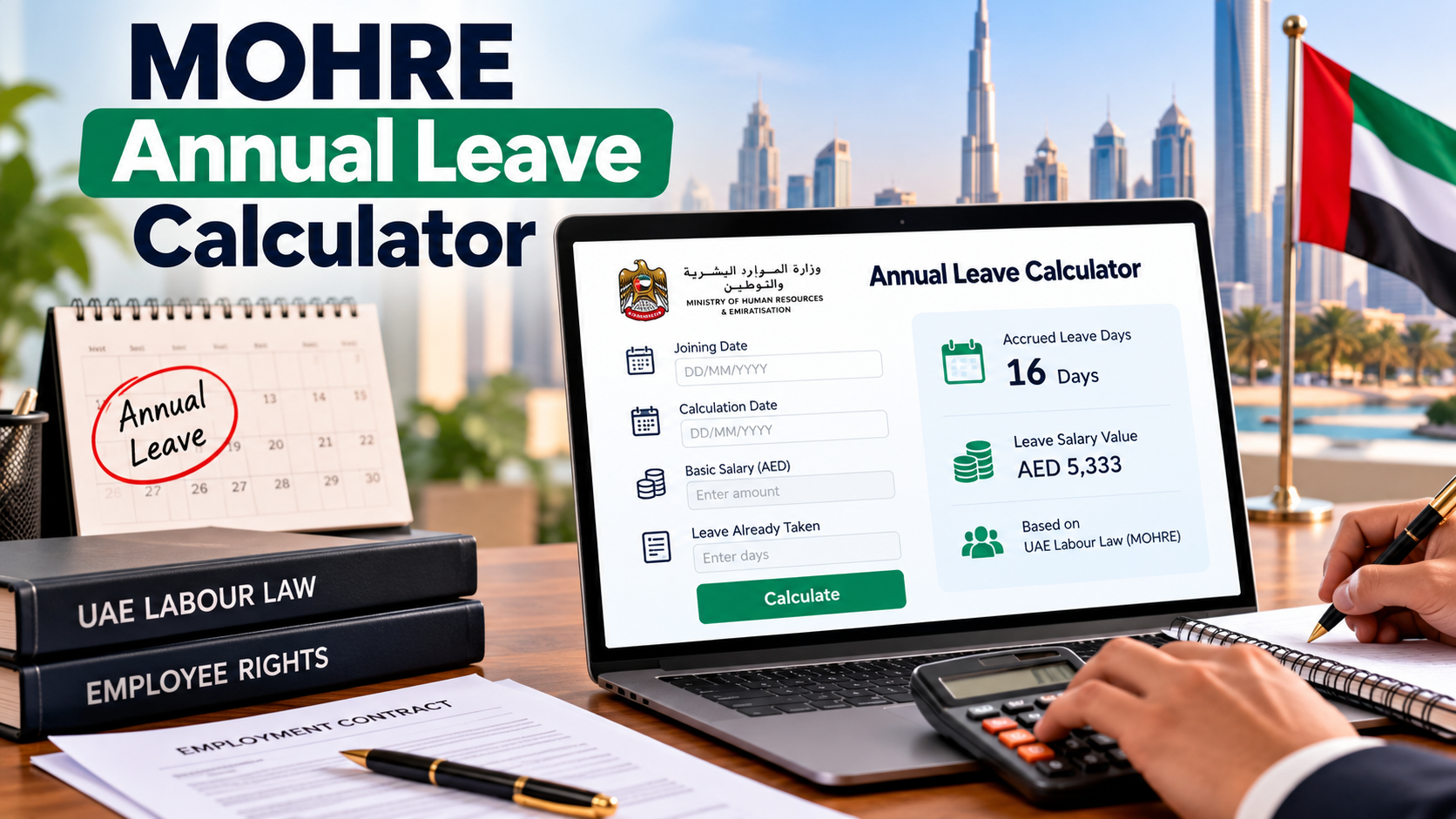
That is the gap a growing number of employers are trying to close with a deceptively modest piece of software: a calculator built around the leave rules enforced by the Ministry of Human Resources and Emiratisation, the federal body known by its initials, MOHRE.
The rules are clear. Applying them is not.
On paper, the United Arab Emirates’ leave framework is straightforward. Under the country’s labor law, an employee who completes a full year of continuous service is entitled to 30 calendar days of paid annual leave. Workers who have served between six months and a year earn leave at a rate of two days for every month worked, so someone eight months into a job has banked 16 days. Before the six-month mark, no paid annual leave accrues at all.
The difficulty lies in the details that real employment produces. People join in the middle of a month. They take unpaid breaks. Probation periods complicate the start date from which leave is counted. Contracts differ on whether unused days can roll into the following year, something the law permits by mutual agreement but does not grant automatically.
Then there is the question of salary. When unused leave is paid out at the end of employment, the calculation is generally based on basic salary rather than the full package. An employee whose contract lists a basic wage of 10,000 dirhams, with housing and transport allowances on top, will see the settlement worked out from that 10,000-dirham figure. For workers who assume their allowances count, the difference can come as an unwelcome surprise. For employers who mistakenly include them, it can quietly inflate costs.
A minute’s work, a month’s headache avoided
The calculators now offered online, most of them free, ask for only a handful of inputs: the employee’s joining date, the date of calculation, the basic salary and any leave already taken. Within seconds, they return the number of accrued days and the cash value of that leave.
The appeal is obvious for the founders of the small companies that have multiplied across Dubai’s free zones in recent years. Many operate without a dedicated human resources department, and the person approving vacation requests is often the same person signing the checks. For them, a tool that applies the legal thresholds automatically offers a quick check before each payroll run.
But the calculators have found an audience among employees, too. Workers preparing to resign increasingly run their own numbers before their final settlement is issued, arriving at exit conversations with a figure in hand. In a labor market where end-of-service settlements are a frequent source of friction, that shared reference point can turn a potential dispute into a brief confirmation.
The moments when the tool matters most tend to be predictable: resignations, redundancies, contract renewals and internal audits of leave balances. It is also useful in the period before a disagreement escalates, when both sides still have an incentive to compare records and settle the matter informally rather than file a complaint with the ministry.
Where the numbers go wrong
Human resources specialists describe a familiar list of errors. The most common is using gross salary instead of basic salary. Others include ignoring probation periods, miscounting public holidays and confusing monthly rates with daily ones.
The quieter problem is documentation. Leave approved over a messaging app, or agreed verbally in a hallway, rarely makes it into a formal log. Contracts sometimes bury leave clauses in language few employees read closely. When a balance is eventually disputed, neither side can prove its case.
Those gaps carry consequences. Miscalculations can lead to underpayment claims and formal complaints, and they become harder to explain when labor authorities request records during an inspection. They also tie into the broader push for wage transparency in the country, where salary payments are increasingly tracked through official systems.
A tool, not a verdict
No calculator replaces a signed contract, and the more careful advocates of these tools stress that their output should always be checked against employment terms and official ministry guidance. Carry-over arrangements, special leave categories and contract-specific clauses can all change the answer.
Still, for an employer trying to stay compliant, or an employee trying to make sure a long-awaited trip home is fully paid, the MOHRE annual leave calculator offers something that has long been in short supply in workplace disputes: a number both sides can agree to start from.
For the founder with the missing three days, that might have meant a quick correction instead of an awkward final conversation, and a departing employee who left on good terms.
For the latest updates and information, keep checking SimpCity.